

Building Coach Bob’s Playbook: How I Used Synthetic Data to Build a Real Team
January 26th, 2026

Coach Bob’s draft class of synthetic players reminded me of something I see in research: when used responsibly, synthetic data doesn’t make things less real — it makes them more human.
Why Rules Alone Can’t Create Realism
By this point, Coach Bob could call plays based on in-game situations. He had rules for structure — no punts except on 4th down, no field goals outside the opponent’s half — that gave consistency, but it still felt incomplete.
What drives our passion for the game isn’t just the rules of the game — it’s the players. A kicker who struggles beyond 45 yards. A receiver who thrives on deep routes but not short ones. A lineman who tires late in the game.
Rules alone couldn’t capture that nuance. To make the simulation feel lifelike, Bob needed synthetic players — data-driven stand-ins with unique strengths and weaknesses. That variability is what made the system more human.
Building the Team
Much like digital twins mimic respondents in research, I built a simple custom model from real player data. These weren’t static replicas of individual athletes, but modeled players that captured realistic traits and tendencies based on those individuals. They gave Coach Bob a roster to work with — and an endless supply of draft prospects.
And that’s exactly the point: synthetic players made the side quest more dynamic and authentic, in the same way synthetic data can make research more reflective of reality.
The Research Process Parallel
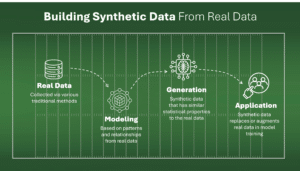
The research process often starts with structure, too. We hold internal meetings, review past work, sift through secondary data, maybe even ask a generic LLM for a broad perspective. Those steps are useful, but they’re largely static. They frame the problem without fully capturing how people actually behave.
That’s where synthetic data can play a role. Used responsibly, it fills gaps. It helps us explore scenarios that traditional methods alone might not surface.
Of course, synthetic data has critics. To some, it feels “made up” or like it could replace real research. But much like Coach Bob’s roster, synthetic data is built from real people with real human characteristics. It’s not a replacement — it’s a complement.
While Coach Bob’s synthetic players were created for fun, they could be used to simulate game situations for deeper game plan insights for enhanced preparation. In the right hands, synthetic data can add the nuance that makes the whole process more realistic and more valuable leading to better human research.
Responsible Boundaries Matter
In the same way I wouldn’t let Coach Bob’s synthetic kicker attempt a 70-yard field goal, we don’t use synthetic data without grounding it in reality. It has to reflect the boundaries of what’s possible.
Done well, synthetic data doesn’t distort insights — it strengthens them. It gives us a way to test possibilities, to see “what if” scenarios, and to enrich the decision-making process.
It’s easy to focus only on the structure — the steps, the quotas, the rules. But in both simulations and research, what makes outcomes meaningful is the variation within the structure. That’s the space where synthetic data adds value.
Looking Ahead
With a roster in place, Coach Bob’s world felt more dynamic and lifelike. But of course, football isn’t played in isolation. Every good coach needs competition.
Which raised the next challenge: who would Coach Bob face on the other sideline?