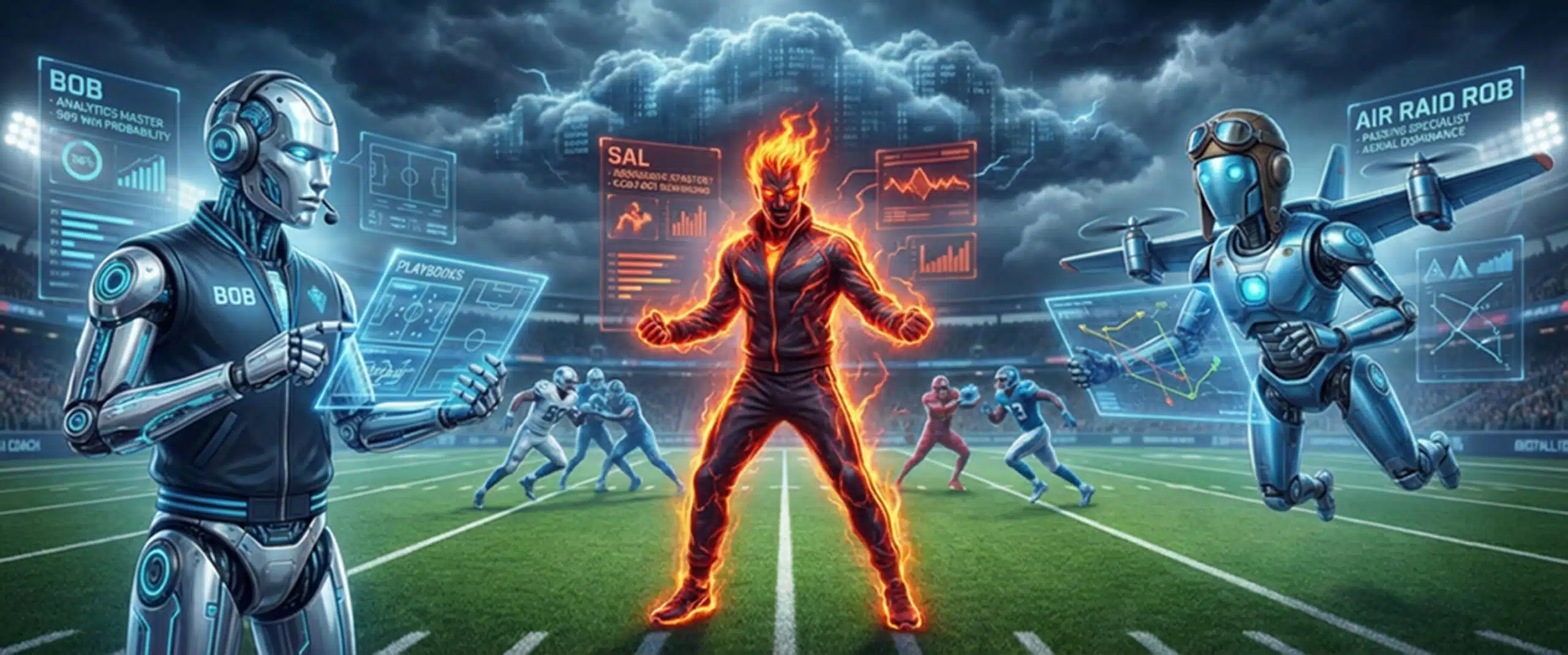

Building Coach Bob’s Playbook — Delving into Personality, an Origin Story
February 2nd, 2026
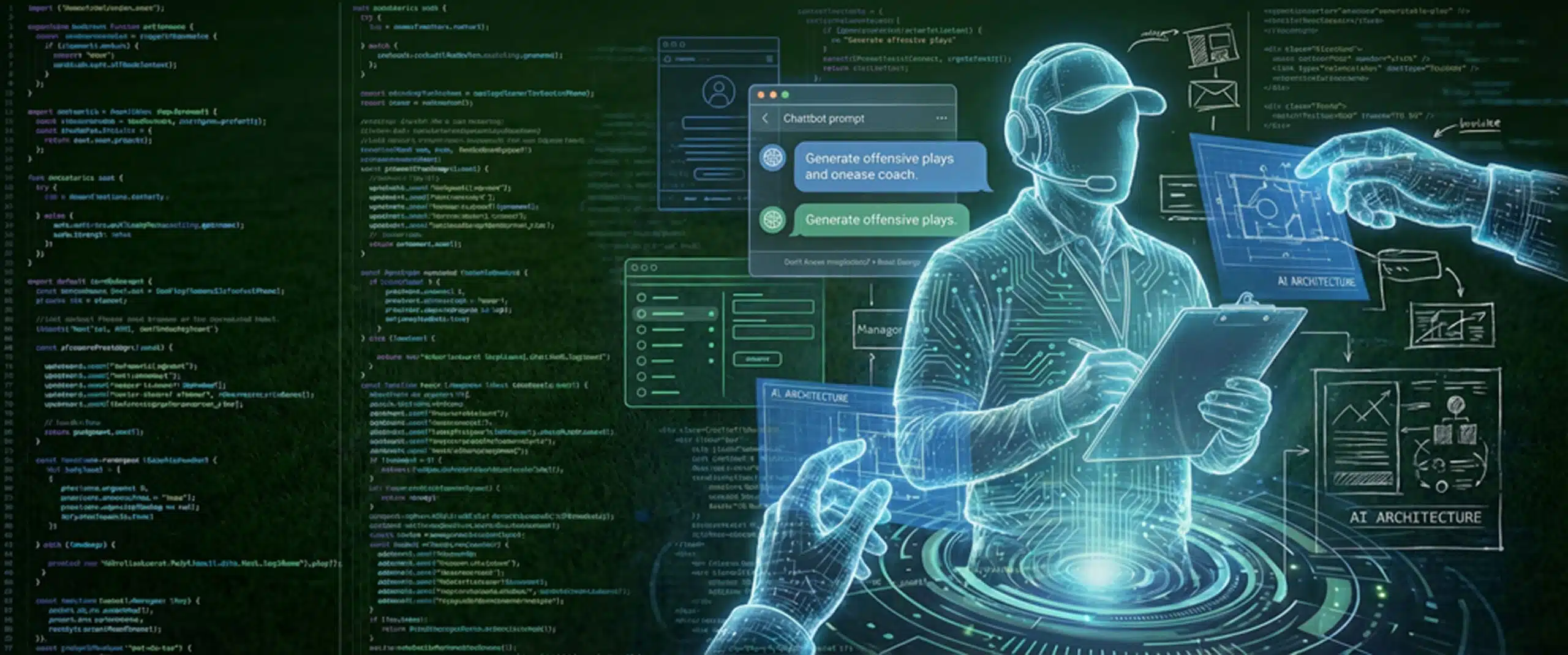
Before Bob could have rivals, I had to look back at how he came to life in the first place — and what that taught me about building personalities.
Before the Rivals… Back to the Beginning
The last article ended with Coach Bob on the field, calling plays with his new roster of synthetic players. But before I could give him rivals with their own distinct styles, I had to revisit what I’d learned when I first built Bob himself: AI isn’t a magic box — the method is what makes it work.
Bob didn’t just “appear” as a personality-driven avatar. I didn’t supply a generic prompt and suddenly have Bob. It took iteration, testing, and design choices. That experience reminded me that when it comes to AI, method matters more than magic — and it set the foundation for thinking about distinct personalities later.
The Essence of Coach Bob
Bob isn’t a digital twin like Coach Bob’s players. He doesn’t try to replicate a real person down to the data. Instead, he’s a digital persona: a curated set of traits, responses, and knowledge designed to feel like a character.
That distinction mirrors conversations I now have daily in research. A digital twin provides precision, modeling an individual or system in detail. A digital persona captures essence, style, or role like an entire segment. Both can be powerful, but both depend on careful design choices.
It was those design choices that ultimately shaped Bob into the “balanced” coach when I extended him into the football world.
The Magic Box Myth
When Bob first came to life, he was more than just a 3D avatar with a voice. I didn’t just ask ChatGPT to “pretend to be Bob.” He was coded from the ground up — text embeddings, information retrieval, local models, and all. That was intentional, because building the pieces myself forced me to confront the design decisions that shape outcomes.
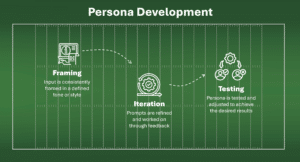
His personality had to be tuned. That meant:
- Framing inputs in a consistent tone so his answers felt natural.
- Iterating on prompts until he sounded more human and less robotic.
- Providing a few examples to anchor his style.
- Testing and adjusting to balance brevity, clarity, and personality.
In other words: Bob wasn’t magic. He was method.
That was the first big lesson of the project — and one that translates directly to research. Whether you’re building a persona, a survey instrument, or a model, outcomes aren’t automatic. They come from design, iteration, and choices.
Why This Matters for Football Rivals and Research
Once I started working on rival coaches, this lesson became even more important. If Bob himself had required that much care to become “Bob,” then creating distinct rivals would take the same thoughtfulness.
And the same principle applies to research. GenAI is powerful — I use it every day — but the results depend on methodology. The data you feed in, the way you structure prompts, the thresholds you set, the decision to frame something as a twin vs. a persona: all of these determine whether the output is useful or misleading.
The temptation is to treat AI like a magic box that “just works.” But just as in research, the questions we ask and the methods we use are what separate insight from noise.
Looking Ahead
With that foundation, it was finally time to put Bob on the field against rivals with their own styles and personalities. Because in football — or in research — it’s the rivalries or contrasts that make things most interesting.