

Collaborating with AI: A New Perspective on Problem Solving in Market Research
March 10th, 2026

Problem Context
At TRC, we are committed to exploring innovative approaches to market‑research challenges. This post offers a fresh perspective on leveraging Large Language Models (LLMs) like ChatGPT and Copilot—not just as answer engines, but as catalysts for deeper thinking.
The role of my team at TRC centers on delivering market share analysis built on sophisticated segmentation frameworks, the kind of structured insights that help clients understand where their opportunities lie, how large those opportunities are, and which consumer groups will drive their growth.
During a recent Market Map study, my team confronted a segmentation challenge; we were working from a single respondent dataset that needed to support two different segmentation schemes. Because both segmentation structures were drawn from the same respondents, the overall weighted averages across both schemes had to match exactly, with no adjustments to the underlying dataset. We knew we could not add or remove respondents or change any of the segment weights. This led to a common question we ask ourselves as market researchers; what do I have and what do I need to solve my problem?
Initially, I considered using an adjustment factor—but because our weighted averages needed to align perfectly, approximations were off the table. That’s when I turned to AI—not to produce a numerical solution, but to help think through the segmentation mechanics at a deeper level.
Initial Interaction with ChatGPT
I approached ChatGPT with optimism, providing a high‑level overview of the issue. However, its initial suggestions—such as using Python or Excel Solver, applying unnecessary formulas, and altering my segment weights —were impractical within the project’s constraints. While those methods could have worked, they introduced extra complexity that ultimately undermined my objective.
Through this stage, I uncovered new learnings about working with AI:
- Broad or vague problem descriptions lead to generic or off‑target suggestions.
- AI pushes you to think more concretely because its responses mirror the clarity (or lack thereof) in your prompt.
- Constraints must be explicitly stated — “obvious” limitations to humans are not obvious to the model.
- Tools you can’t use (Solver, Python, macros) need to be called out early to avoid irrelevant recommendations.
Refining the Problem Through AI Engagement
After some time, I found that providing a certain level of specificity transformed the interaction into something that resembled a collaborative problem‑solving session with a colleague—just without interrupting anyone’s workflow. To better show how refining prompts influences better output, see below a comparison of my initial and final prompts.
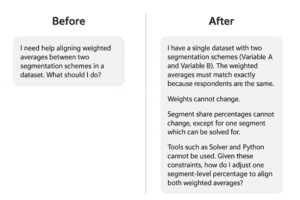
As you can see from my final prompt, my “lightbulb moment” then came when I reiterated that the segment weights could not change. That realization made it clear that one of the segment‑level percentages would need to be solved for to bring both sets of weighted averages into alignment. AI didn’t solve my problem; it helped bring the solution into focus.
Opportunities AI Created in This Process
- Deepened my understanding of the mechanics of the dataset.
- Forced me to slow down and articulate mathematical relationships more precisely.
- Created a structured space for problem decomposition without pulling colleagues away from their work.
- Helped supply my team with a concrete solution to future segmentation problems when analyzing market share.
Key Takeaways
While my experience with ChatGPT wasn’t revolutionary, it underscored a meaningful lesson: sometimes the act of talking through a problem—even with an imperfect partner—can be more valuable than receiving an instant solution.
Here are the core takeaways from the experience:
- AI can serve as a sounding board that strengthens your clarity of thought.
- Constraints must be spelled out explicitly to get relevant guidance.
- The value of AI is not only in the answer it gives, but in how it helps define the problem.
- Digital collaborators can support strategic problem‑solving without disrupting teammates’ focus.
In our fast‑paced environment, it is easy to rush toward an answer or overlook the tools we already have. Every business problem is unique, and models like ChatGPT and Copilot can serve as effective digital collaborators, supporting more thoughtful and creative problem‑solving. At TRC, this matters deeply. Our market share work depends on building precise, reliable segmentation frameworks that clients use to guide real business decisions. By integrating AI into our segmentation and share analysis workflows, we’re not replacing our expertise—we’re enhancing it. Ultimately, it enables us to deliver even stronger, more actionable insights for the brands that rely on us.