
AMA Baltimore’s Career Workshop: A Market Research Practitioner’s Take on AI and Career Readiness
April 20th, 2026
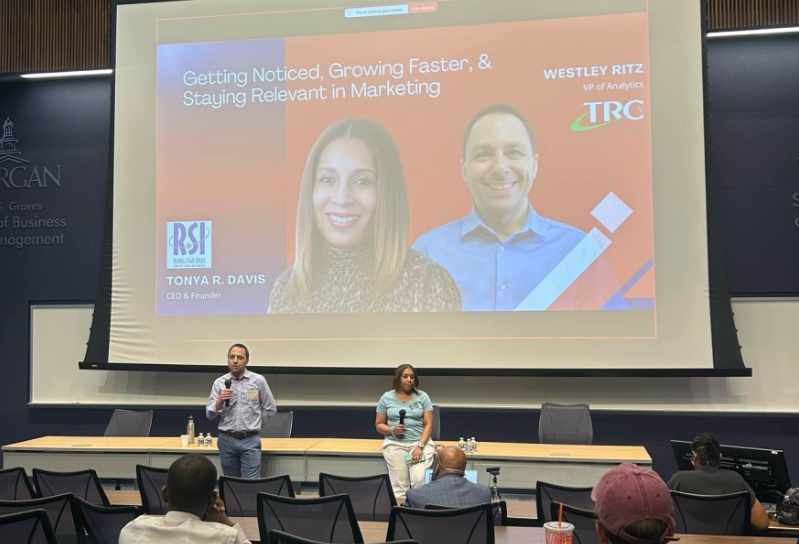
Engaged. Curious. Sharp. Thoughtful. And, as a bonus, not at all bothered by having to show up on a Saturday. Those are the words I’d use to describe the students I met this past weekend at AMA Baltimore’s 2026 Collegiate Career Connections Workshop: Marketing in the Age of AI: From Classroom to Career Connections.
Over the course of the day on Saturday, April 18, 2026, AMA Baltimore brought together students, professionals, and academics at Morgan State University’s Earl G. Graves School of Business and Management to talk about how AI is reshaping marketing, and what that means for the students who are about to step into it. Morgan State hosted, Johns Hopkins Carey Business School sponsored, and AMA Baltimore (in collaboration with the Morgan State University Student Chapter of AMA) put the whole thing together. I had a seat on the panel.
My seat at the table on AI
When the AI conversation got underway, I walked through the three ways it actually shows up in my work at TRC.
First, the everyday. We use AI daily for efficiency: drafting, summarizing, cleaning up messy text, spotting patterns in data, all the small stuff that used to eat the margins of a project. Not glamorous, but it gives us back hours every week.
Second, the activities we already did, now done better. AI helps us pressure-test a survey instrument before it goes live, sharpen a deliverable long before it reaches a client inbox, and stress-test the assumptions behind our recommendations.
Third, using AI to do things we couldn’t or weren’t doing until recently. This is the category getting most of the R&D attention at TRC right now. Digital twins and synthetic personas are two examples we’re actively working on. The focus is on identifying where these approaches deliver the most value, and then scaling what works.
The students were the story
The questions from the floor weren’t the surface-level “tell us about your day” prompts you sometimes get at student events. They were pointed. What skills should I double down on if AI is already handling entry-level tasks? What does “good” look like when the tools are moving this fast?
And the questions kept coming when the panel ended. During the structured networking session, I watched students rotate between tables of researchers, brand strategists, analytics leaders, and agency folks, genuinely trying to pick brains rather than collect business cards. A few came back later to follow up on something I’d said earlier in the morning, which is which is one of the clearest signals that the conversation landed. A roomful of future marketers was doing real work on a Saturday.
A thank-you to the organizers
Events like this don’t run themselves.
AMA Baltimore put together a program that earned the students’ time, which is harder than it sounds on a weekend. The Earl G. Graves School of Business and Management at Morgan State University opened their doors and set the tone; it’s a building that takes business education seriously. And Johns Hopkins Carey Business School stepped up as a sponsor, helping keep the event affordable and accessible for students.
Thank you to all three. I hope this becomes a fixture on the Baltimore calendar.
Continuing a tradition at TRC
At TRC Insights, staying connected to academia isn’t something we do on the side. We collaborate with marketing science and AI researchers at institutions like Columbia Business School, often leaning on them as thought partners and advisors as we design and refine our own research (including this recent paper for Quirk’s). We also draw on that academic pipeline to inform what we bring to our clients. Showing up at Saturday’s event, which puts practitioners and the next generation of marketers into the same room, fits squarely in that tradition. The best insights tend to come out of that kind of mix.
To the students who gave up a Saturday to ask hard questions about AI and marketing: thank you. Keep asking them. And a few of you, I suspect, will be the ones shaping where this goes next.