

Can AI Moderate Qualitative Interviews? What a Fintech Pilot Revealed
April 30th, 2026

Yes, AI chatbots can conduct qualitative interviews. In a recent TRC Insights pilot using AI-Moderated Interviews for fintech consumer research, the AI led natural-feeling, structured conversations and delivered a positive respondent experience.
A few years ago, I wrote a blog about missing the market research interviewer in the era of online surveys, and I never thought I’d be enthusiastic about a technology that could replace interviewers for qualitative, in-depth interviews. However, recent developments in AI have created genuinely exciting opportunities to incorporate qualitative interviews into more projects.
AI-Moderated Interviews (AIMI) are more efficient than traditional one-on-one interviews, saving both time and money. Because these interviews are asynchronous, participants can take part on their own schedules. Sessions can run simultaneously, around the clock, and in multiple languages, enabling broader and more inclusive participation.
This all sounds great, but can a chatbot really replace a skilled human moderator? Can it ask relevant follow-up questions? Can it carry on a natural conversation? Based on recent experience, the answer to all these questions is yes.
A Real-World Example Using AIMI in Fintech Consumer Research
TRC has run several pilot projects to test the effectiveness of AI moderators for in-depth consumer interviews. I was recently involved in one of these pilots, in which respondents were recruited from a quantitative survey about household expenses, spending, and financial management. The objective of the qualitative phase was to gain deeper insight into how consumers shop across channels and how they choose to pay.
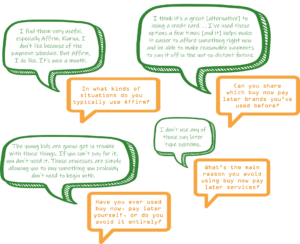
The conversations between consumers and the AI moderator were remarkably smooth. The AI asked useful follow-up questions based on participants’ responses and probed additional points from preloaded interview instructions (sometimes referred to as “training data”) when appropriate. The illustration below shows examples of the AI’s probes following consumers’ initial responses to a question about buy-now-pay-later services.
Most participants remained engaged throughout the interviews, providing thoughtful and detailed answers. When asked to share feedback on their experience with AIMI, consumers generally rated it positively, describing the process as easy, enjoyable, and seamless. Several participants specifically noted the AI’s ability to understand and build on their responses, while others said they felt more at ease than they would in a human-moderated interview.
It’s also worth noting that the sample wasn’t limited to younger, tech‑savvy respondents. We had strong representation from older consumers, including participants in their 60s, who were just as comfortable engaging with the AI moderator.
Key Takeaway: AIMI Broadens Opportunities for Qualitative Research
AI‑Moderated Interviews offer a practical way to expand the role of qualitative research—making it more affordable, faster, more scalable, and more accessible without sacrificing depth. As our pilots demonstrated, well‑designed AI moderators can conduct natural conversations, ask relevant follow‑up questions, and create an experience that participants find comfortable and engaging.
That doesn’t mean AI should replace human moderators entirely. High‑stakes decisions, deeply exploratory work, and some sensitive topics are still best handled by experienced interviewers who can read nonverbal cues, probe intuitively, and navigate cultural nuance. Unlike humans, AI can only probe within the boundaries of what it has been trained to recognize and ask.
AIMI should be viewed as a strategic complement to human moderators. When used intentionally, they make it possible to scale routine qualitative research and reserve human moderators for the projects where their judgment and expertise matter most. Despite my initial skepticism, I’m embracing this new tool and looking forward to expanding our qualitative insights.