
ABC of Digital Payments
March 30th, 2023
Imagine this scenario:
There are three countries, say A, B, C, that have their own versions of road systems.
In Country A, roads are completely owned by private entities. They are aplenty and of varying quality – but road switching generates a transaction fee. Roads are not built to uniform standards, so there’s a compatibility issue for cars which means some cars can’t go on certain roads.
In Country C, travel is much smoother and frictionless, but unlike Country A, the governmental overlords monitor every detail – so roads can be easily shut down when deemed necessary.
Country B takes a middle path where the roads are operated by independent non-profits. In other words, it has built an efficient public-private system that allows seamless travel without power grabs.
If roads is too much of a 20th century metaphor, imagine electric vehicles and access to charging stations as your choice of metaphor and the same principle still holds.
Now, you likely didn’t have much difficulty uncovering that Country A is America and C is China. Bharat is another name for India, so you could forgive my cutesiness.
Why labor through these metaphors?
Because the future is easier to understand as an extension of the known present (or as Master Yoda would say, “Cloudy the future is”). Such is the case with digital payments where future infrastructure is being built right now – in these three parallel pathways.
What makes the middle path of India so awe-inducing is the ambition and audacity, given the size of the country and its lack of abundant resources. “India Stack” as the process is known is not some fancy academic musing – started at least a decade ago it is continuously and heavily tested.
The first layer of India Stack was the issuance of a unique identification number to more than a billion citizens – itself a monumental task given the circumstances.
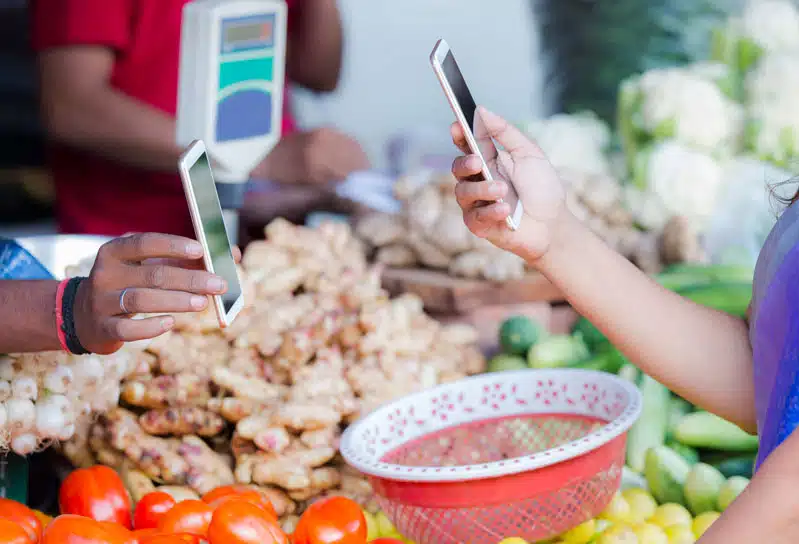
The next layer was the development of a financial backbone (using open-sourced software), primarily in the form of the Unified Payments Interface (UPI) that allows various parties (buyers, sellers, exchangers, whoever) to plug-in with mobile phones and seamlessly transact in real time. UPI is the fifth largest payment network in the world (behind OGs Visa/MC, and the newer AliPay and WeChatPay).
(Browsing the news here in India on my vacation, I just learned about the introduction of a UPI-Lite system for speeding up low-value transactions, as well as the potential export of UPI to some neighboring countries – all of which will likely provide another significant boost).
The third layer is, of course, secure data-sharing without which none of this magic can happen. Taken together, this system is described by some as “the largest API on Earth.”
Among the stunning results is this gem – the unbanked population in India has fallen from 80% to 20% in just seven years thanks to minutes-long digital authentication (instead of days/weeks). An offshoot effect is that Government benefits can be directly and digitally transferred, eliminating middlemen pilfering.
One ultimate aim of the system would be to eliminate interoperability problems like “Tesla-won’t-charge-GM-EVs” in our metaphor, or “Venmo-can’t-pay-Zelle”.
The ambition extends beyond with more services to be offered in this public-roadways-private-cars model. One such is the development of a commerce backbone to allow any vendor, however small, to be able to sell digitally. Think of a non-profit Amazon. . .
No doubt, adherents of the other two models would have their objections to this system. But I’m in awe of the vision that dares to dream of a low-cost bespoke digital infrastructure of the future.
End Notes
Much more detail on India Stack – can be found here: https://tigerfeathers.substack.com/p/the-internet-country
UPI (through e-mandate and e-lien) can potentially facilitate smart contracts, an alluring feature of blockchain technology that, among other things, can provide documented future revenue streams for content creators.
Sign up for Rajan’s Funsights Newsletter for regular updates.