

World Cup Odds and the Art of Smarter Market Research
June 15th, 2026
As the most-watched tournament in the world kicks off, here’s the real question:
“What can FIFA World Cup prediction models teach us about making better business decisions?”
Every four years – and as Team USA set off on their quest for glory – fans look to pundits, rankings, and gut instinct for that near-impossible certainty. But increasingly, the best answers come from somewhere else: data science.
This matters more than just within soccer. Because at its core, World Cup prediction modeling reflects the same challenge businesses face every day: how to make smart decisions in the face of uncertainty. And that’s exactly where strong research and advanced analytics can make the difference.
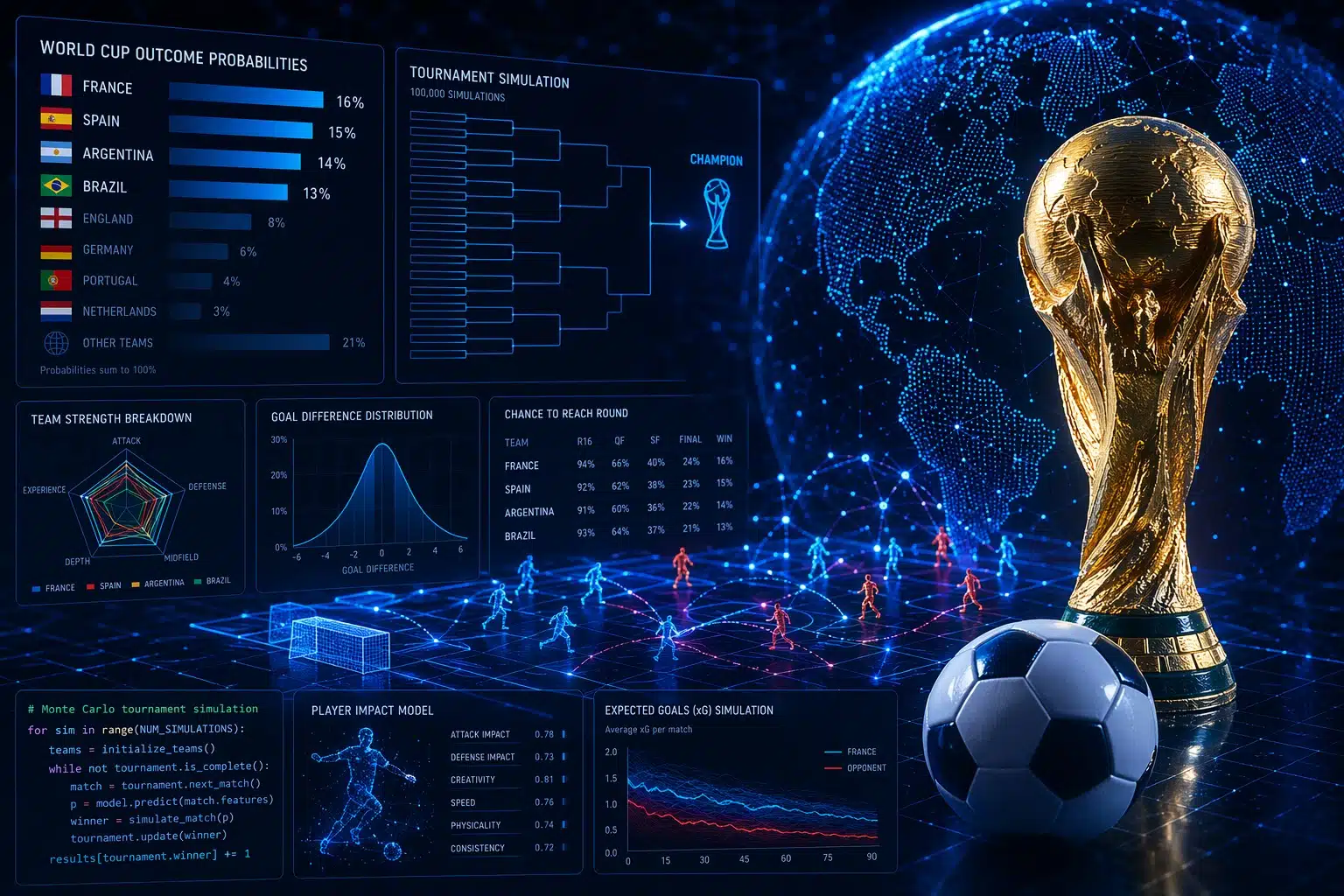
Unlike those from eras passed, modern World Cup prediction models don’t try to declare a guaranteed winner. Instead, they assess likely outcomes based on a combination of past performance, current strength, and simulated future scenarios.
At a high level, they tend to:
- Rate teams using historical performance and other key indicators
- Model match outcomes probabilistically, not as fixed results
- Simulate the tournament thousands of times to understand the range of possible outcomes
The result is not a single answer. It’s a distribution of probabilities.
This provides a powerful lesson for business leaders and researchers alike: the goal is rarely to fully eliminate uncertainty. Instead, we should strive to measure it, understand it, and make better decisions because of it.
Even the strongest teams in these models often have surprisingly modest odds of actually winning the tournament. In other words – as we can see below from prediction modeling consensus – even the favorites lose far more often than they win.
Teams with highest win probability for the World Cup 2026:
- France: 16%
- Spain: 15%
- Argentina: 14%
- Brazil: 13%
The same dynamic shows up in business all the time. So, how should you tackle it?
Commonly, decision-makers incorrectly seek answers to questions like:
- Will this program succeed?
- Will consumers switch?
- Will this message drive XYZ behavior?
But the better question to ask is usually: How likely is that outcome – for whom, under which conditions, and why? That shift in mindset is key to producing better research and subsequently, better business recommendations for clients.
At TRC Insights, we apply this way of thinking every day. And, while we may not be (at least currently) running models for soccer tournaments, we are helping our clients understand human behavior through a lens of greater precision, confidence, and actionability.
For example, within health program engagement – using the same principles that make World Cup models so effective – we do not simply ask if people will enroll.
Instead, we direct our view to:
- Which segments are most likely to enroll
- Which audiences are most likely to remain engaged
- Which messages are most likely to drive behavior
Similarly, when focusing on insurance switching behavior, we know decisions are rarely driven by a single factor alone.
Just as the outcome of a soccer match depends on more than raw talent, switching behavior depends on a variety of influences, including:
- Cost sensitivity
- Trust in the brand
- Prior experience
- Perceived value
- Context of decision
Our job is not to predict one universal outcome, but to identify who is most likely to act, what drives that likelihood, and how these insights can better shape strategy and decision making.
Thinking that data science and advanced analytics provide a crystal ball is an easy trap to fall into, though in reality, they help us make decisions with greater discipline and value.
At TRC Insights – particularly within our highly skilled analytics team – we put this approach into practice through high-impact, real-world work. Every day, we help clients make smarter choices about design, communication strategy, engagement initiatives, and more.
Whether you’re managing a national soccer team or building a product, the best decisions don’t come from predicting the future; they come from understanding likelihood, possibility, and where to go next.
That is the real value of data science, and the value of great research. Because in the end, the winners are rarely the ones who guess best. They’re the ones who use data best.
Sources:
Towards Data Science (2026) [towardsdatascience.com]
University of Innsbruck (2026) [uibk.ac.at]
CupIndex (2026) [cupindex.com]
FootballForecast (2026) [footballforecast.io]
Predict0 AI (2026) [predict0.ai]
Bracket Research (2026) [bracketresearch.com]
WorldCupStats (2026) [worldcupst…s.football]