

Solutions & Products
New Product Research
Why do only a handful of new products succeed and many others fail?
It’s often because critical marketing opportunities are overlooked.
A smart approach to market research for new product development will help you see new ideas, expanded targets, and other considerations.
We’ll not only help you get more out of your new product development work—we’ll provide you the expertise needed to turn consumer feedback into useful insights.
Our Approaches
Present a set of choices and you’ll find out what your target truly values.
Max-Diff and other choice-based methods, including our proprietary products Bracket™ and Message Test Express™, can help you make better decisions.
Kick-start ideation with Idea Mill™, a fast and inexpensive way to generate and validate new product ideas.
We can help you understand buyer trade-offs, and valuate a range of different packaging options so you can make intelligent pricing decisions. We can also help with more straightforward concept testing and price-demand techniques.
New Product Market Research Case Studies
We helped these clients prioritize product features, understand purchase intent, and prepare for market-ready pricing.
What we’ve learned from new product development research
Marketing a new product successfully means knowing which key features to emphasize, which campaign concepts resonate, and if additional opportunities reside within. Our experience in market research for new products taught us smart ways to get to those critical answers.
Blog insights on market research for product development
Shouldn’t your market research be customized to you?
You are unique. Your business challenge is unique. That’s why your market research should be customized to work for you. Let’s talk about working together to help you find new audiences, new insights, even new ideas.
Todd FabianHeinz
“The TRC folks are knowledge experts on a wealth of analytic methodologies and, more importantly, know how to match those methods to your business need.”
Teresa AndersonBlue Cross Blue Shield of Vermont
“TRC provided thoughtful guidance—taking the lead on the process and ensuring that the research answered all of our questions.”
Russ SenykLuye Pharma
“Your willingness to talk through my needs and curiosity about them sets you apart from the other firms I’ve used.”
Susan TopelCentene Corporation
“Have I said thank you for all that you all have done? Please express my sincerest and overflowing gratitude for how agile and responsive your team has been.”
New Product Development: Stages and Methods
The new product development process has the potential to be haphazard because of the inherent uncertainty in the process, as well as the myriad methods available for product development. Setting up an organizing framework to identify the stages in the process, and the methods applicable to each stage, should help in bringing order to the process.
Our purpose in this article is to lay out a framework and identify key methods that are most likely to be useful in each stage of the product research process. The focus here is on methods that use quantitative data collected mainly through the web thus bringing more validity and flexibility to the process along with speed to market.
We envision the new product development process as an iterative multistage process as shown in Figure 1.
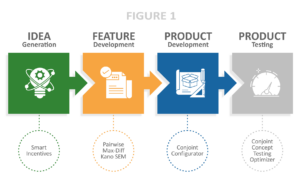
This is a straightforward way of looking at the process that starts with idea generation, moves to development of individual features and then to full product development and finally into product testing. Of course, this is one example of how the process can be viewed and not a rigid framework. There has to be considerable fluidity in the system to accommodate feedback, skipping of stages, use of new methods and perhaps introduction of new stages.
Idea Generation
Many methods are available for the idea generation stage such as brainstorming, Delphi and focus groups. The basic approach is to harness creativity in some form for the development of new ideas. While there is much to recommend for the more qualitative approaches, one of the drawbacks is the lack of quantitative validity to the ideas at this stage. That is, the ideas have not been shown to have popularity in the constituency that matters – the customers. We have found that the Smart Incentives approach can provide both creativity and validation in the same step. Respondents to a survey compete with each other to produce ideas thus introducing creativity into the process. The generated ideas are then evaluated by a peer group to provide the required market validation. This approach can be useful for generating ideas on both whole products and individual features. [Please refer to the article You May Get More Than You Pay For for a more complete explanation of this topic]
Feature Development
Feature development is the process of identifying features that would be of interest to customers. Traditional methods such as Importance Scales can be used, but may not provide sufficient discrimination between features. Pairwise comparisons of features are a straightforward method for identifying feature importance. The task is simple, but can be tedious if a large list of features needs to be culled. More recently developed methods such as Max-Diff scaling can provide a better alternative. Max-Diff is similar to pairwise comparison, except that more than two features are evaluated at a time (3-5) and the most and least preferred alternative is chosen from each set. Some advanced statistical analysis on the back end provides a score for each feature that is generally more discriminatory than a regular importance scale. [Please refer to the article Identifying Feature Importance: A Comparison of Methods for a more detailed explanation]
Another alternative is the Kano method where the positive and negative aspect of each feature is rated in order to distinguish the “must have” features from the “nice to have” features. [Please refer to the article Asymmetry in Product Features: Use of the Kano Method for further explanation on this topic]. The final method in this stage (that straddles this and the next stage) is the Self-explicated Method (SEM). Respondents rate the desirability of each level of each attribute as well as the importance of each attribute. Combining these two pieces of information gives attractiveness scores (similar to conjoint utilities) for each attribute level. Although all attributes and levels are rated by respondents (as in conjoint analysis), since they are presented individually, this method may be more appropriately seen as useful for feature development. [Please refer to the article Conjoint Analysis Versus Self- Explicated Method: A Comparison for a more complete explanation of this topic]
Product Development
In this stage, combinations of features are used to build or evaluate the product. The Configurator allows survey respondents to build their ideal product by selecting from a list of available features. Usually prices are provided at the feature level to ensure that respondents make realistic decisions. As respondents build their own ideal products, the most popular features and feature combinations rise to the surface, resulting in the automatic development of preference based market segments. [Please refer to the article Product Configurator for a more complete explanation of this topic] The Optimizer is different in that respondents make choices from among fully formed products. Information from their choices is taken into account in creating successive products that are more preferred till the process finally converges on the respondent’s ideal product. This method is more appropriate when the design and packaging (i.e. the visual element) is more important. As with the Configurator, the market segments itself into preference based segments.
The various flavors of conjoint (such as traditional, discrete choice, adaptive) can also be used in this stage to identify feature importance. But care has to be taken to ensure that the basic assumptions are met and that the right type of conjoint is used. [For a more detailed explanation of conjoint analysis, please refer to the article Understanding Choice in Banking: Use of Discrete Choice Conjoint Analysis.]
Product Testing
Conjoint analysis can be fruitfully used in this stage also to estimate the interest in various product combinations and especially in running market simulations. The latter ability is very important in cases where a strong competitive market exists and reasonable estimates of take rates and ability to choose the ideal combination for the market are requisites. Concept testing is much more limited than conjoint and is usually used when the product is almost set except for perhaps one or two questions, often relating to price. [Please refer to the article Monadic Versus Laddering Pricing for a comparison of pricing techniques] Assessing the market’s appetite for the product in its current form is the overriding objective of concept testing.
In short, the chaos of the product development process can be structured, and appropriate methods applied, to gain maximum benefit at different stages.