

Integrating MaxDiff Analysis into Pricing Research
April 24th, 2025

A New Twist on MaxDiff Changes the Way We Think about Pricing
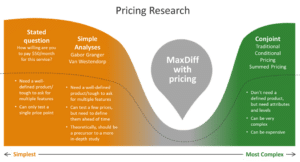
In the realm of marketing research, identifying effective pricing strategies is a critical piece of consumer insights. Business leaders need to answer essential pricing questions: What is the optimal price for our product? How many pricing tiers can the market support? What features are consumers willing to pay more for? Addressing these questions requires a range of methodologies, from simple pricing analyses to more advanced modeling techniques.
One such approach is MaxDiff Analysis, a widely used technique for measuring the relative importance of product attributes by having respondents select the most and least important options from a set. Traditionally, MaxDiff has been employed to prioritize features, benefits, and messaging, offering clear insights into consumer preferences. However, its application in pricing research has been limited.
A new innovative approach that integrates MaxDiff with pricing research will be explored in this article. This method not only provides a ranked preference of features but also incorporates pricing as a key variable, forcing respondents to make real-world trade-offs. The result is a more actionable and cost-effective way to derive optimal pricing insights that align with consumer expectations.
Max-Diff in Action: Beyond the Basics of Feature Ranking
MaxDiff, short for Maximum Difference Scaling, is a survey-based research technique used to quantify preferences. Respondents are presented with a set of items, like 10-20 new product features, and asked to choose the most and least important or appealing options. This forced-choice mechanism requires respondents to make trade-offs, resulting in a robust ranking of items based on their relative importance. It is much stronger than a simple 5-point scale. Common applications include:
- Feature Prioritization: Identifying which product or service features are most valued by consumers.
- Message Testing: Determining the most compelling marketing messages or claims.
- Brand Attribute Evaluation: Assessing which brand attributes resonate most with the target audience.
The strength of MaxDiff lies in its ability to mitigate common survey biases, such as scale use bias, by requiring respondents to make explicit choices between options. This results in more discriminating data compared to traditional rating scales.

Price Is (Also) Right: Merging MaxDiff with Pricing Strategy
While conjoint analysis has been the go-to method for pricing studies, it can be expensive and time consuming. Integrating MaxDiff into pricing research offers unique advantages. By incorporating price (or discounting) as a variable within the MaxDiff framework, researchers can assess not only the relative importance of features but also how price influences consumer preferences. This approach provides a nuanced understanding of the trade-off’s consumers are willing to make between price and product attributes. Here are some details about the new method:
- Designing the Study: Develop a mix of prices, features, and discounts that vary systematically.
- MaxDiff Exercise: Present respondents with subsets of these profiles, asking them to select the most and least preferred options in each set.
- Data Analysis: Analyze the choices to determine the relative importance of each feature and price point, as well as their interactions.
This method allows researchers to quantify the value consumers place on specific features and how sensitive they are to price changes, facilitating the identification of optimal pricing strategies. The result is actionable recommendations in the final output.
Two Real-World Examples:
The following examples show two distinct ways to apply MaxDiff with pricing in practice.
1.MaxDiff with Features and Discounts
Scenario: A sports team is trying to come up with ways to improve their season ticket packages.
Approach:
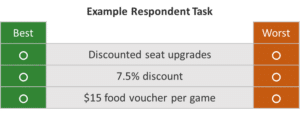
- Features Tested: 3 direct discounts (from 5-10%) and 6 additional features and/or discounts.
- Price Points: Evaluated at different levels with direct discounts or free items like food vouchers or parking.
- MaxDiff Design: Respondents are shown sets of feature-discount combinations and asked to identify the most and least appealing in each set. Each respondent is presented with 8 exercises, which is an optimal number to provide robust data and avoid respondent fatigue.
Findings:
- The exclusive presale offering is preferred and should be featured in marketing communications and promotions.
- Direct discounts (especially at levels below 10%) are not particularly motivating to consumers.
- Exclusive giveaways and a dedicated customer service rep are not interesting features to consumers.

Implications: The team can optimize season ticket packages by promoting exclusive presales, food vouchers, and free parking.
2. MaxDiff with Products and Pricing
Scenario: A subscription-based gym membership service wants to determine the optimal pricing model for its different tiers and benefits.
Approach:
- Products Tested: Membership tiers ranging from basic to premium, each with different sets of benefits.
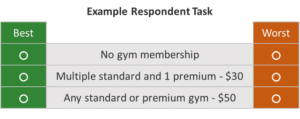
- Price Points: Evaluated at different levels, from $10-$50 per month. We also gave a “no membership” option to see at what point consumers will walk away.
- MaxDiff Design: Respondents are presented with different membership-price combinations and asked to select the most and least appealing options.
Findings:

- The majority of consumers prefer the mid-tier membership at $20-$30, striking a balance between features and affordability.
- Few are willing to pay additional fees beyond $40, even when offered exclusive benefits.
Implications: The service provider can optimize their pricing structure by focusing on the $30 tier while introducing targeted benefits to justify premium pricing.
Limitations: The Fine Print of MaxDiff with Pricing
While integrating MaxDiff with pricing research offers valuable insights, certain limitations should be considered:
- Design Complexity: Incorporating multiple products and price points can lead to many combinations, increasing the complexity of the survey design and potentially overwhelming respondents. Think about 5 products and 4 prices – that is already 20 combinations in total. This number can get high very quickly, and it is important to balance it with respondent fatigue.
- Cognitive Load: Respondents may experience mental overload when evaluating numerous attributes alongside pricing, which could affect the reliability of their choices.
- Sample Size Requirements: Robust statistical analysis requires an adequate sample size, especially when dealing with numerous attributes and price points. This of course, can lead to longer field times and higher project pricing. At a minimum, projects like this require a sample size of N=400 or larger, depending on design and goals.
Turning Preference Data into Profitable Pricing
Integrating MaxDiff Analysis into pricing research offers a sophisticated approach to understanding consumer preferences and price sensitivities. By requiring respondents to make explicit trade-offs, this methodology provides precise insights into the relative importance of product features and acceptable price points. With these data-driven insights, brand managers can refine pricing strategies, optimize product offerings, and maintain a competitive edge in the market.
This unique design retains the standard output of a traditional MaxDiff analysis—prioritizing features based on consumer preference—while adding a second dimension: pricing. By incorporating price into the trade-off decisions, researchers gain a more realistic and context-rich understanding of consumer behavior. This ensures that pricing strategies are built on real-world insights.