

AriZona Iced Tea Pricing Strategy: A Price Anchoring Case Study
June 1st, 2026
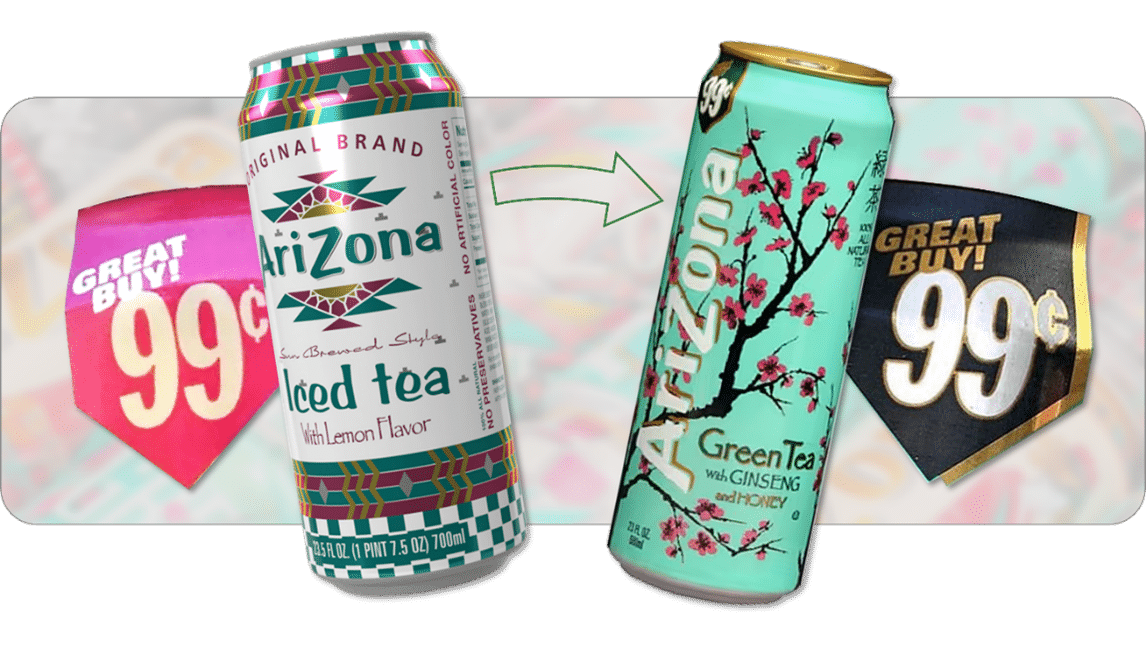
Recently, two of my sons (10 and 12 year old boys) discovered AriZona Iced Tea. When I was a young buck, in the 1990s, AriZona Iced Tea had just launched and it was very popular. I was also a big fan around that same age.
I was quite surprised when I noticed that it still said “99 cents” on the can. I thought to myself “that can’t possibly be the actual price…I am pretty sure it was 99 cents when I was a kid over 30 years ago, and inflation has been raging for several years now, not to mention increasing raw material costs, and tariffs”. So, I dug into this a bit more and the story is truly amazing, so I am here to tell it!
AriZona And Price Anchoring and Inflation – A Brief History
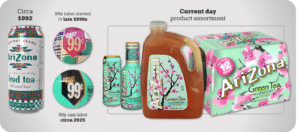
AriZona has indeed held the 99 cent price point for over 30 years (since 1992), which is almost unheard of in the world of CPG (consumer packaged goods). What makes this even more interesting is that they didn’t just keep the price: they turned it into a brand promise by printing “99¢” directly on the can in the late 1990s to prevent retailer markups. And 30+ years later – they are still fighting that same battle!
Now let’s layer in inflation:
- $0.99 in 1992 ≈ $2.30–$2.40 today (2026 dollars) Source: U.S. Bureau of Labor Statistics CPI Inflation Calculator.
- That’s roughly a +130% to +140% increase in general price levels.
So, in real dollar terms, AriZona has effectively cut its price in half over the past 30 years.
From a pricing research perspective, this is a classic example of extreme price anchoring. Consumers don’t just prefer the 99 cent price – they expect it, and anything above it feels like a violation of the brand. The current Chairman and founder of AriZona, Don Vultaggio, has made affordability and value part of the brand for years. Here are a couple quotes:

Through the lens of my kids, it is easy to see the appeal of a 99 cent can of AriZona Iced Tea (or Mucho Mango or other varieties). It is cheap! It is hard to get anything for a dollar these days, especially in a convenience store setting. So, when one of my kiddos goes in with 5 bucks, he’s aiming to maximize value, thinking a drink, snack, and candy, which is tough to do.
Side Note – in the town of East Hampton, New York, at the IGA to be more specific, a can of AriZona Iced Tea was $1.29 – blasphemy! Now, take into consideration, the East End of Long Island, and specifically East Hampton is a vacation community and one of the most expensive places in the country. And even there, they barely moved off the 99 cent price, even though it was still on the package. Everywhere else in our experience – still 99 cents!
As an expert in pricing elasticity research and shrinkflation, here are the main questions I wanted to answer:
- Has AriZona changed the size of the can? Nope – still 22 ounces, same since the late 1990s. (although it was 23.5 ounces at the very beginning…we will ignore that little piece of shrinkflation)
- Have they changed the actual product in the can? My initial thought was that watering it down would be an easy way to save on margins. AriZona claims no, and I do believe them. The nutrition labels and ingredients look similar over the years.
- What about profitability? Do they have investors? AriZona claims they have taken a margin hit over the years…obviously! But, they are privately held with Vultaggio holding close to 100% of the company. They don’t have debt and just maybe profits aren’t the #1 priority, since Vultaggio is already a multi-millionaire. This is very rare in the corporate CPG world, especially for a 30+ year old company like AriZona.
Another quote from Vultaggio: “AriZona is privately held and debt-free, which allows the company to make decisions without shareholder pressure.”
In fairness, AriZona also has other product formats – like the 12-pack of cans, a one-gallon jug, and more. They presumably have higher margins on those, to help with the overall bottom line. The 99 cent can is only a fraction of AriZona’s overall sales. So, the 99 cent can may break-even, or slightly less, and still be OK for the company.
Coca-Cola: A Historical Example of Price Anchoring
Coca-Cola faced a similar pricing issue. From roughly 1886-1959 coke was 5 cents. You read that correctly…that is over 70 years with the exact same product and price! AriZona still has a way to go.
Coke faced a lot of price anchoring issues over this period; the main one was that a very large percentage of Coke was sold in vending machines. By design, these machines only accepted nickels and they didn’t give change…this was a problem.
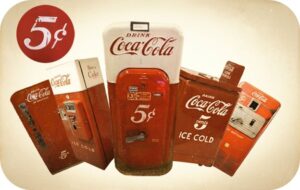
When Coca-Cola seriously tried to raise the price after World War II, it was very tricky, because of the distribution system and consumer perception. Eventually, around 1959, Coke managed to re-configure the machines to accept dimes and give change. This is when the pricing went to 10 cents a bottle – a 100% increase! But it wasn’t smooth for about a decade. Coke messed with vending machine configurations and even lobbied the U.S. government to mint a 7.5-cent coin. Understanding that going directly from 5 cents to 10 cents was a huge increase and may seriously damage the brand. (Source: NPR Planet Money, “Why Coke Cost A Nickel For 70 Years”.)

The Tipping Point For AriZona
Assuming AriZona Iced Tea stays in business for another 40 years…they will have to raise the price at some point….or will they?
There are several factors that could push AriZona over the tipping point, and here are my leading candidates:
1. Aluminum Prices
- Aluminum is one of the biggest pressure points for AriZona, and it has been extremely volatile.
- Aluminum prices have increased significantly over the past decade and spiked during supply shocks.
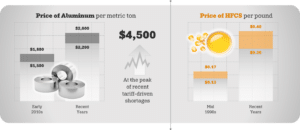
- In recent years, prices have hovered around $2,200–$2,600 per metric ton, compared to closer to $1,500–$1,800 in the early 2010s.
- At the peak of recent tariff-driven shortages, U.S. aluminum buyers paid over $4,500 per metric ton when combining the global aluminum price, U.S. delivery premiums, and tariffs.
- Source: World Bank Commodity Markets (Pink Sheet) / IMF Primary Commodity Prices
2. Sugar Prices – While sugar prices are often discussed when talking about beverage costs, most iced tea and soda products – including many AriZona varieties – are sweetened with High Fructose Corn Syrup (HFCS).
When AriZona launched its 99 cent can in the early 1990s, HFCS prices were relatively low.
- Mid-1990s HFCS price: roughly $0.13–$0.17 per pound (dry weight equivalent)
- Recent HFCS prices: roughly $0.30–$0.40 per pound in recent years
- Source: USDA Economic Research Service (ERS) Sugar and Sweeteners Yearbook.
That means HFCS prices have roughly doubled to tripled since the 1990s, creating another source of cost pressure for beverage producers trying to hold retail prices steady.
For a beverage company selling billions of cans, even small ingredient cost increases matter — especially when the retail price of the product hasn’t changed in more than three decades.
3. Water Costs: AriZona Beverages is headquartered in Woodbury, New York (Long Island), but production is spread across the U.S. to reduce shipping costs.
Water itself is relatively low cost, but:
- Industrial water + treatment + energy costs have risen recently
- Northeast utilities (NY region) tend to be higher than national averages
- Water isn’t the biggest driver – but it contributes to overall cost pressure.
4. Shipping Costs: As I write this article in March 2026, gas prices have gone nuts, therefore shipping prices have risen too. Any liquid product, like AriZona, is very heavy and expensive to ship.
It could also be a combination of these factors that pushes AriZona over the tipping point, where they can no longer survive selling 99-cent cans.
Recommendation for AriZona – Price Optimization Research With Consumers
If AriZona is ever in a position where the company is seriously considering raising prices, they should conduct some price elasticity research to measure consumer perceptions and response to a higher price for the 99 cent can.
Any price increase will have some impact on consumer demand and brand equity, and it is a delicate balance for AriZona.
The best way to conduct this type of price sensitivity analysis is to run a choice-based conjoint analysis with AriZona and competitive products. Here are the basics:
- Run an online survey with US consumers who drink iced tea on a fairly regular basis.
- Obtain a decent sample size to reduce sample error and increase statistical reliability – N=1,000-2,000 would be good.
- Give consumers a shopping exercise with varying brands and prices – include competitors like Snapple, Lipton, Peace Tea, etc.
- Run simulations that show pricing demand curves, revenue curves and profitability.
- Give recommendations on pricing strategy for AriZona.
Prices to consider – AriZona should test a few different prices in this research:
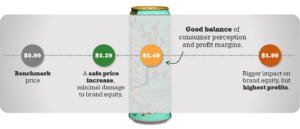
- $0.99 – Use as a benchmark price, to reference against competition and other AriZona prices.
- $1.29 – a very safe price increase that many consumers will likely be OK with. AriZona would still be very favorably priced against competition. Downside is that the margins may still be slim, and AriZona might have to consider another increase over the next few years.
- $1.49 – This may be the best balance of consumer perception and increased margins. It would also be a good price to lean into over the next 20+ years.
- $1.79 and-or $1.99 – It would be interesting to test these prices to see the drop in consumer demand and perception. $1.99 would make AriZona comparable to other brands, so would customers still buy it? Also – $1.99 may have a massive impact on brand equity and trust.
Conclusion
The AriZona story is ultimately a lesson in price anchoring. For more than 30 years, consumers have associated the brand with a simple promise: a large can of iced tea for 99 cents. Over time, that number has become part of the product itself, which makes any future price increase a brand decision and a financial one.
AriZona may eventually reach a tipping point as aluminum, sweetener and shipping costs continue to rise. If that moment comes, careful pricing research will be critical. Understanding consumer price sensitivity, competitive context and demand elasticity can help brands navigate price changes without damaging long-term brand equity.
There are many ways to conduct pricing research, the simplest being monadic-split cell research, or Gabor-Granger, or Van-Westendorp Price Sensitivity Meter.*
Conjoint research is more complex and always includes competitive context, so it is more accurate for big decisions, like AriZona may face soon.
Until then, AriZona’s 99 cent can remains one of the most remarkable pricing stories in the CPG world and a great reminder that sometimes the most powerful number in marketing is simply the price. My kids definitely agree!
*Learn more about pricing research on the TRC Website – Monadic Split-Cell Pricing Research: A Simple Method for Price Sensitivity Testing – TRC Insights.
Contact Ted Benzing
Visit Ted’s bio page
Frequently Asked Questions (FAQ Section)
What is price anchoring?
Price anchoring is when consumers latch onto a reference price – usually the first or most familiar one – and judge every later price against it. AriZona’s 99-cent can is an extreme case: shoppers are so anchored to that number that any increase feels like a violation of the brand. Measuring how strong an anchor is, and what happens if a brand moves off it, is central to TRC’s pricing research.
How do you test a price increase?
You test a price increase by measuring how demand and brand perception shift across a range of candidate prices, instead of guessing. Common methods include monadic split-cell tests, Gabor-Granger, the Van Westendorp Price Sensitivity Meter, and choice-based conjoint when competitive context matters. TRC’s pricing research uses these techniques to model demand and revenue curves before a price ever changes.
What is conjoint analysis used for?
Conjoint analysis is used to uncover the trade-offs people make between features, brands, and prices by asking them to choose among realistic product options. Because it builds in competitive context, it suits high-stakes pricing and product decisions and produces demand simulations rather than stated opinions. It is the backbone of TRC’s conjoint analysis work across pricing, new product, and brand equity studies.