

Monadic Split-Cell Pricing Research: A Simple Method for Price Sensitivity Testing
March 18th, 2026

Introduction – Pricing Research Today
Companies spend a significant amount of money each year on pricing research in the United States. Pricing research has become especially important in recent years due to inflation, tariffs, and ongoing supply chain disruptions. These factors often force companies to evaluate whether price increases are necessary to maintain profitability.
The total U.S. marketing research industry generates roughly $36 billion annually, according to IBISWorld. If pricing-related studies account for approximately 5–15% of research spending, the total investment in pricing research likely falls between $2–5 billion each year. Granted, this is a very rough estimate, but the point is that a TON of money is spent on price optimization research.

Much of this spending goes toward complex price elasticity research or pricing optimization studies, often using advanced techniques such as conjoint analysis. These approaches can be very valuable when testing multiple product features, bundles, or large product portfolios.
However, many business situations do not require that level of complexity. In many cases, simple pricing research techniques can provide clear insights into price sensitivity and demand curves.
One of the most effective and underutilized approaches is Monadic Split-Cell Pricing Research. In this article, we’ll review the basics of this method and walk through two example use cases.
The Basics of Monadic Split-Cell Pricing Research
Monadic Split-Cell Pricing Research is one of the cleanest ways to conduct pricing analysis.
In this survey design, each respondent sees only one price point, randomly assigned, and balanced based on key demographics. The concept, product description or product video remains identical for all respondents. The only variable that changes is price, which isolates the impact of price on demand.
After seeing the concept and price, respondents answer key metrics such as:
- Purchase intent
- Perceived value
- Product uniqueness
- Overall appeal
Many commonly used pricing techniques — such as Gabor-Granger or Van Westendorp Price Sensitivity Meter — expose respondents to multiple price points during the survey. Savvy respondents often recognize that they are evaluating the same product at different prices, which can introduce context bias and influence responses.
Another issue is that despite being widely used for decades, there has been limited empirical validity testing on these approaches. While they remain popular and useful in many cases, they may introduce bias because respondents realize that pricing is being manipulated.
Monadic split-cell design avoids this problem entirely.
Advantages of Split-Cell Pricing Research
Monadic split-cell pricing analysis offers several advantages:
- Each respondent sees only one price, reducing anchoring and comparison bias
- Provides a clean read on price sensitivity
- Isolates the direct impact of price on demand
- Produces clear price elasticity curves
- Often less expensive than conjoint pricing research
When to Use Split-Cell Pricing Research
This approach works best under certain conditions.
- Mass-Market Products or Services
The method works best when the product category is common and easy to recruit respondents for. Ideally, the category should have an incidence rate above 30%. - Limited Number of Price Points
Split-cell studies typically require N≈150 respondents per cell for reliable results. If you test too many prices, sample size and cost can increase quickly. In most cases, 3–6 price points works well. - Limited Subgroups for Analysis
Split-cell technique works fine if there are only 2-3 subgroups (max) for analysis. Otherwise, the sample sizes need to be quite large. - Simple Product Structures
If the product has many variations (features, bundles, flavors, or service tiers), a pricing conjoint analysis may be more appropriate. - When Price Impact Must Be Isolated
Split-cell designs are ideal when teams want confidence that any demand differences are driven purely by price rather than survey context or other factors.
Use Case 1: Pricing Research for a Tech Toy Manufacturer
Imagine you are the Marketing VP for a mid-size toy manufacturer producing a tech-enabled kids toy that interacts with children through games, images, and learning activities.
Business Challenge:
A global memory chip shortage has significantly increased component costs. Material costs for chips have already risen 22% over the past year, and suppliers expect an additional 30–40% increase next year. While this is a hypothetical example, the global chip shortage is a real thing – the surge in AI data centers has forced chip manufacturers to shift production toward high-bandwidth memory used in AI servers, reducing supply of smaller standard memory chips and driving shortages in consumer electronics.
Your product currently retails for $149.99, but your operations team estimates that a $10–$30 price increase will be required to maintain a reasonable profit margin.
To understand demand sensitivity, you run a split-cell pricing research study among parents with children ages 6–12, the core target audience.
Example Split-Cell Design:
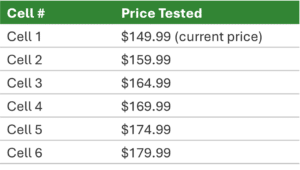
Each respondent views a short product concept or video, then answers key survey questions including purchase intent, perceived uniqueness, and price-value perception.
The resulting analysis produces a price-demand curve showing how purchase intent changes across price points.

In this example, demand declines significantly after $164 suggesting that the optimal pricing strategy is to increase the price by $15 to that level, but not higher.

Consider competitive response as well. If competitors also use the same memory chips, then will they likely raise price too? Think about adding 1-2 more cells for a wider variety of prices or consider a conjoint analysis if the competitive landscape is more complex.
Use Case 2: Pricing Research for a New Product Launch
Business Challenge:
Now consider an entrepreneur launching a new product. Competitive products sell between $19.99 and $34.99, and your cost structure and margin analysis suggest that pricing somewhere between $24.99 and $34.99 would be profitable.
The business owner is considering three realistic pricing options, so a simple split-cell pricing study will work well here.
Example Study Design:
- 3 price cells – $24.99, $29.99, and $34.99
- N=150 respondents per cell
- Short 5-minute survey – product concept or video shown with price (each respondent sees one price only)
- Key metrics collected include purchase intent, perceived value, uniqueness, and open-ended feedback.
With just three cells, you will get a very basic price elasticity chart, like the one below. This chart shows two lines, one is price vs. purchase intent, and the other shows revenue per 1,000 potential customers at each price point.
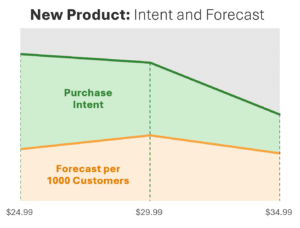
The pricing decision is easy here, $29.99 is best option based on this data. The interest drops off after $30, and the forecast revenue is highest at $29.99.
Include a 4th cell with the leading competitor at their most common price. This will allow you to see the demand of your product relative to an established competitor.
Conclusion – Price Sensitivity Research Options
While many sophisticated pricing research techniques exist today, sometimes the best approach is a simple, unbiased pricing analysis.
Monadic Split-Cell Pricing Research provides a clean and efficient way to measure price sensitivity, demand curves, and revenue optimization without the complexity of advanced models.
For many products and services, this straightforward approach can provide clear, actionable pricing insights at a reasonable cost.
If you need assistance designing or executing a pricing study, TRC Insights conducts pricing research for a wide range of clients, from simple split-cell tests to complex pricing optimization and conjoint analyses.
Our goal is simple: help companies make smarter pricing decisions!
Sources:
https://www.ibisworld.com/united-states/industry/market-research/1442/
Martin, B. & Rayner, B. (2008). An Empirical Test of Pricing Techniques. American Marketing Association Advanced Research Techniques Forum
https://www.reuters.com/world/china/ai-frenzy-is-driving-new-global-supply-chain-crisis-2025-12-03/