
Understanding, Mapping, and Disrupting the Digital Customer Journey
Introduction to Digital Customer Journey Mapping
Evolving from traditional journey mapping that we discussed in the first paper on the customer journey, this journey has become more complex as the marketing world changed and as multiple options have emerged for researching options, seeking opinions, purchasing channels and for feedback loops in the world of social media.
This is not an easy process to observe and even harder one to dissect and to diagnose. So we use a combination of techniques and tools to help us make sense of the journey at every step, from social listening to SEO to qualitative ethnography, and surveys linked to third party data bases to help us determine where and when to target disruption (see Figure 1).
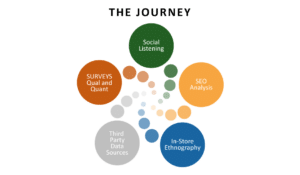
Figure 1
Figure 2 shows a simplistic layout of how to map out the steps in the journey and which tools we apply at each stage, from pre-store/channel decisions to the actual trip mission which leads to the experience itself.
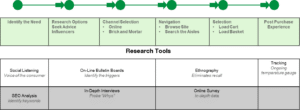
Figure 2
The used tools represent different ways to understand what the consumer is doing and why they are making their decisions at each step of the process.
Here is an example of what a customer journey map may look like for an OTC health care product in a brick and mortar setting. This starts with the identification of a need for relief and works through each of those moments of truth as shown in Figure 3: research, consideration, channel selection, the in-store experience, and what happens after selection and use.
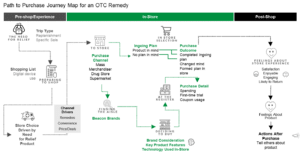
Figure 3
Similarly, we can illustrate a Journey Map for a consumer on track to purchase remedies digitally. The key differences surround how the consumer ultimately selects the site they visit, who or what influences them on their journey, what they select and why, and whether or not they place their selection in the cart, and if they actually went through with the purchase. Later in this paper, we demonstrate ways brands can influence the selection of their brands and how to influence digital purchases even if the cart is abandoned.
So let’s walk through a typical journey and explain the tools we use, why and what we learn in the process to help on the back end.
The first step is to identify what happens before the consumer makes a purchase. The examples in this paper assume a brick and mortar shopping experience, but the presented content is applicable for any sales channel.
The first step is to understand the words and phrases used by consumers to describe their needs, experiences and/or the products and brands they are using in their own authentic words and not in what is commonly referred to as “Corporate Speak.”
Figure 4 provides an example in the financial planning space. Verbatim comments and the most common words and phrases used to describe the discussions people are having about retirement planning were first extracted via a social listening analysis. We then used the most frequently used words to conduct an SEO analysis to identify what search terms are most common.
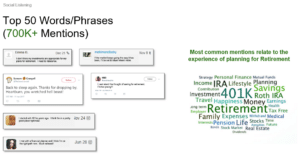
Figure 4
Figure 5 gives an example of three search terms representing 90% of all searches, which has implications for where to allocate all resources on the digital side of the equation to generate optimal results in digital paid search, such as Google Ads.
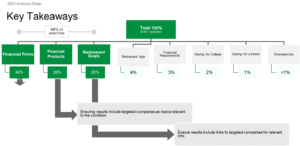
Figure 5
Then we conduct research to better understand thought processes — both rationally and emotionally. We use an assortment of qualitative techniques, which can include but not be limited to: electronic bulletin boards, in-depth interviews, and on-location events utilizing geofencing technology. We use these techniques to probe the thought process of how consumers make their decisions. This also enables us to deeply analyze the consumer thought process by visiting them where they live to talk about how different consumer needs affect their purchasing decisions. Figure 6 provides an impression of such a visit.

Figure 6
Moving on to the in-store shopping experience, we align the journey with our learning objectives. We aim to measure experiences, behaviors, and attitudes before, during, and post purchase experience. Thus, our research questions are as follows:
RQ: What is the customers’ need, what is available to them, and where do they shop currently?
RQ2: How does the customer navigate the store aisles to find a product, and what are the feelings involved in their decision?
RQ3: Did they purchase what they came to the store for, did they make a different purchase, or did they make no purchase at all?
This is designed to get at behaviors as well as the experience—both rationally and emotionally.
To understand the in-store experience, we conducted mobile surveys with over 2000 consumers, who fit our profile for qualification (suffered from a particular ailment). We used geo-fencing technology by pushing out surveys and tasking them to comply with the shopping assignment once they crossed the threshold of the specific retail location. In this case, the locations were drug stores and mass merchandisers. Below are a couple of screen captures of videos consumers uploaded during their shopping assignments.

Figure 7
And this it typically where our responsibilities end. We analyze, hypothesize, report, present, lead activation sessions, develop personas, create infographics, all with the intent of socializing the information across the culture of the client organization. It is then usually up to the brand team and their agencies to develop advertising and media strategies to attract and retain customers.
But what if we could disrupt behaviors? What if we could leverage technology to motivate a lost customer to purchase our product after all hope was lost? Adobe has presented their Customer Journey Orchestration product, powered by the Adobe Experience Platform, during their last two Annual Adobe Summits. It represents and advancement in digital technology that not only tracks and individuals journey, but can be instrumental in disrupting it and positively affecting their behavior.
“Journey Orchestration” is fundamentally different from the traditional “Campaign Orchestration,” as journey orchestration anticipates the needs of individuals and fulfills those needs at scale in real-time instead of campaign orchestration merely anticipating the needs of segments at-scale and then waiting for the campaign trigger.
Figure 8 shows a chart presented at the recent Adobe Summit (in April 2021) that highlights such differences.[1]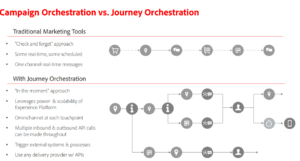
Figure 8
Using this technology, it is then possible to affect behavior in real-time. For example, we can engage customers in response to abandoned actions by delivering real-time location-based experiences as presented in Figure 9.
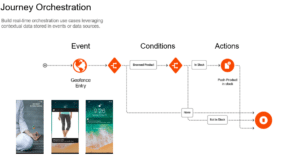
Figure 9
A customer of “Luma,” a yoga studio in California, enters the studio’s front door and the Luma app on her smartphone immediately triggers a geofencing signal that alerts the system of her presence in the studio. The experience platform then identifies a condition that indicates the individual was browsing the Luma website for new yoga pants but abandons her cart instead of completing her online shopping. The system immediately checks Luma’s inventory and finds that they have the item in stock. The individual is alerted of an offer on her phone letting her know the specific yoga pants are available and that she can purchase them on-site for a 10% discount today.
Conclusion
The customer journey is not linear—far from it. This paper has shown it must be viewed holistically to uncover key “Moments of Truth” that enable marketers and companies to positively disrupt and optimize the customer journey. We must understand the “what” as well as the “why” of customer behavior, both rationally and emotionally. Importantly, as societies and economies around the world are more rapidly changing than before the COVID-19 pandemic, we as marketers and business leaders must understand our need to adapt to emerging customer behaviors and journeys.
[1] Summit 2021 Build Your Customer Journey Using Adobe Journey Orchestration Powered by Adobe Experience Platform.
 Unlike many of my colleagues at TRC, I never really wanted to be in market research. My dream from an early age was to be either a locomotive conductor, a Zamboni driver or the guy at the amusement park that starts up the roller coaster. I went to college for chemistry, but quickly realized that I didn’t want to be a chemist. So I went to Business School where my goals shifted to either being a Brand Manager for a CPG company, or a Madison Avenue Mad Man, complete with big expense accounts and three martini lunches. Truthfully, they would have to pour me into a bucket if I ever consumed three martinis.
Needless to say, I wound up landing a job at General Foods learning how to do market research from some of the smartest people in the field. That led to a stint at Pepsi-Cola at the tail end of the Pepsi Challenge era and smack into the Michael Jackson years. Shifted to the agency side where I transitioned from a small company partnership to larger and larger global networks. I’m really happy to be back in the more manageable sized firm loaded with really talented professionals.
Over the year, I have probably worked on almost every industry vertical helping clients domestically and globally, with a particular expertise in Pharma/Biotech, Consumer Healthcare, Financial Services, CPG and BTB. I help clients solve their problems with techniques that leverage years of experience in segmentation, branding, communication, journey mapping and customer experience.
I am a lifelong learner, and have a wide range of interests, like learning to rock climb, achieving a 2nd degree Black Belt in Tae Kwon Do, becoming a bartender, learning to cook and teach cooking professionally and most recently fine woodworking. I also drove an Indy car an average speed of 122.6 mph and went trekking in Nepal for three weeks to see Mt Everest in 2019. This may explain why I have trouble focusing during a Zoom call.
Education: AB in Business and Chemistry University of Chicago; MBA in Marketing and Finance Booth School University of Chicago
TRC Clock: Since 2021