
Understanding, Mapping, and Disrupting the Customer Journey: Traditional Journey Mapping

Introduction
Today, consumers are asking for highly personalized experiences, which includes specific marketing and customer service efforts. To cite industry stats, according to Salesforce 80% of consumers now consider their experience with a company to be as important as its products, and 69% of consumers want to talk with a company in real-time.[1]
This, of course, leads us to ask: How can we optimize for the best customer experience possible for our brand? Can we map out the customer experience to determine the customer journey and its various stages of the buying process? This mapping process has been simply termed “Journey Mapping.”
In this paper, we will share with you the various tools that are available to us as we face the Fourth Industrial Revolution, which represents the blurring of boundaries between the physical, digital, and biological worlds. To remind you, previous Industrial Revolutions included the advent of Mechanical Production (water, steam) Mass Production (electricity and the Division of Labor) and Automated Production (electronics and IT.)
This fourth revolution will be a fusion of advances in artificial intelligence (AI), robotics, the Internet of Things (IoT), 3D printing, genetic engineering, quantum computing, and other emerging technologies. [2]In the second paper, we will look at the evolving customer journey that goes beyond traditional journey mapping.
This paper seeks to construct a visualization of the roadmap that consumers take on the journey as they react to stimuli, seek information from multiple sources, plan their shopping trip and execute, or in many situations, navigate many roadblocks and barriers to their destination. What better way to anticipate the pitfalls your customers might have in finding and purchasing your brands? The goal is to identify how to make the trip easier and less painless to increase sales and market share.
The customer journey has evolved significantly over the years, and we will later demonstrate some examples of how we employ several techniques to observe and diagnose what happens during this journey—before, during and after the purchase.
In order to gain a better understanding of where we need to go, let’s have a look at where we all started. This is an example of how marketers had typically viewed a customer journey. It is a fairly simplistic and too linear way considering what happens with consumers in the real world.
It also forms the basis for how we have constructed surveys to track our markets over time.
Consumers methodically “funnel” down a competitive landscape of brands as they narrow their consideration set down to a managed number of select options. Their initial purchase is made and then subsequent purchases are influenced by any number of factors. We typically call the repeated purchase of the same brand “Loyalty,” although, depending on the investment required for time and/or money, this repeated purchase may just be habitual. Figure 1 visualizes this.

Figure 1
Looking at how our understanding of this process has evolved over time and more importantly, understand how technology has impacted this journey as we explore the concept of “The Moment of Truth”. The first mention of such a moment appeared by Jan Carlzon, president of Scandinavian Airlines, who was applying his theory to customer service in the 1980’s: “Any time a customer comes into contact with a business, they have an opportunity to form an impression.”
This concept was picked up again two decades later in 2005 by P&G, adapting the model to consumer sales from customer service and developing the “First and Second Moments of Truth” at the shelf as well as subsequent experience with the product itself.
In 2011, Google[3] came up with the ZMOT (zero moment of truth), the point at which consumers are researching a product online, prior to a purchase. This was an important step in fully understanding how consumers are influenced, and how they process information to help them make decisions, whether they are rationally, or emotionally based. In 2014, Eventricity, an event-driven marketing consultancy came up with the <ZMOT model to identify the point at which a consumer identifies a need as shown in Figure 2.
A New Mental Model
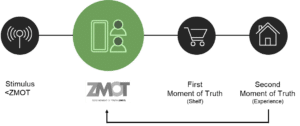
Figure 2
Marketing has certainly come a long way from the simplistic funnel approach (see Figure 1). But regardless of how many moments of truth we uncover, it is obvious that this is not a linear customer journey. As shown in Figure 2, it starts with the identification of the need, and it leads through the process of how someone decides on their choice of a product or service, all the way through to the purchase and post purchase experience.
This is how we view the customer journey, which is much more of a cycle as shown in Figure 3—which can either repeat itself multiple times with little effort, or can require a much more thoughtful approach in the decision making process.
The top half of the model addresses the “Activation Path,” is all about understanding the need for a product and then it works through the selection of a brand. After the experience, either the expectations are fulfilled and the path repeats itself, or the path is disrupted and the process has to start all over again with the collection of alternatives and the selection of brand that will hopefully better serve the need originally identified.
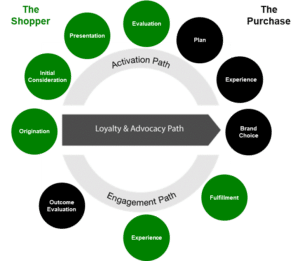
So how do we keep up with the process evolution as consumers have more and more alternatives available to them as they engage with their surroundings to solve their needs and meet or ideally exceed their expectations? As digital tools become available to us as marketers, we can leverage technology to have a 360° view of the digital customer journey to fulfillment.
[1] https://www.salesforce.com/uk/blog/2016/03/customer-journey-mapping-explained.html
[2] https://www.salesforce.com/blog/what-is-the-fourth-industrial-revolution-4ir/
[3] Google: ZMOT, Winning the Zero Moment of Truth, 2011, https://www.thinkwithgoogle.com/marketing-resources/micro-moments/2011-winning-zmot-ebook
 Unlike many of my colleagues at TRC, I never really wanted to be in market research. My dream from an early age was to be either a locomotive conductor, a Zamboni driver or the guy at the amusement park that starts up the roller coaster. I went to college for chemistry, but quickly realized that I didn’t want to be a chemist. So I went to Business School where my goals shifted to either being a Brand Manager for a CPG company, or a Madison Avenue Mad Man, complete with big expense accounts and three martini lunches. Truthfully, they would have to pour me into a bucket if I ever consumed three martinis.
Needless to say, I wound up landing a job at General Foods learning how to do market research from some of the smartest people in the field. That led to a stint at Pepsi-Cola at the tail end of the Pepsi Challenge era and smack into the Michael Jackson years. Shifted to the agency side where I transitioned from a small company partnership to larger and larger global networks. I’m really happy to be back in the more manageable sized firm loaded with really talented professionals.
Over the year, I have probably worked on almost every industry vertical helping clients domestically and globally, with a particular expertise in Pharma/Biotech, Consumer Healthcare, Financial Services, CPG and BTB. I help clients solve their problems with techniques that leverage years of experience in segmentation, branding, communication, journey mapping and customer experience.
I am a lifelong learner, and have a wide range of interests, like learning to rock climb, achieving a 2nd degree Black Belt in Tae Kwon Do, becoming a bartender, learning to cook and teach cooking professionally and most recently fine woodworking. I also drove an Indy car an average speed of 122.6 mph and went trekking in Nepal for three weeks to see Mt Everest in 2019. This may explain why I have trouble focusing during a Zoom call.
Education: AB in Business and Chemistry University of Chicago; MBA in Marketing and Finance Booth School University of Chicago
TRC Clock: Since 2021